

The Wildebeest Migration – every year almost two million Wildebeest, zebra, topi and antelope migrate from the vast Serengeti Plains in Tanzania, to the lush rolling grasslands of the Masai Mara, in Kenya. The journey is 1,800 miles and tough and arduous, with many animals falling prey to Africa’s lion, leopard and cheetah – not to mention the crocodiles which lie in wait each year for that first wildebeest to cross the Grumeti and Mara Rivers. Seeing the sheer magnitude of animals amongst the wildebeest migration, as well as the drama and action this extraordinary natural spectacle provokes, is nothing short of miraculous.
See our fantastic Specialist Wildebeest Migration Safari – a combination of the Masai Mara and the Serengeti.
Great Migration Safari Holidays: the basics
- You can see the Great Migration in Tanzania all year round – they migrate in a circular motion around the Serengeti National Park as such it is an ongoing event. Below we will dissect where the wildebeest usually are at different times of the year.
- The Great Wildebeest Migration is rarely in the Masai Mara Kenya; the herds only ever venture there as an extension of their grazing lands in the northern point of Tanzania if they need to for fresh pastures. You can only find the migration in Kenya within a few months of the year when they head towards the border, and even then, most of the herds are still mulling around the northern parts of the Serengeti anyway…
The best times to visit The Wildebeest in Africa
- July – October: This is when the wildebeest are in the northern Serengeti plains, and you have a chance of seeing up to thousands crossing the great Mara River. As the sight of the wildebeest crossing the so dramatic, it is considered by many the most desirable time to see the migration.
- December – March: Currently the wildebeest are in the southern area of the Serengeti, more specifically in Ndutu which is actually in the Ngorongoro Conservation Area, and it is calving season. Along with the river crossings, this is a real highlight of the wildebeest’s journey and a fabulous time to see the herds congregate on the dramatic sweeping plains of the south. February is the only time of year when you are almost guaranteed to see the big herds all together as they always come south for calving season.
- The rest of the year: In November, April, May and June the migration is “in between” locations and as such these months are slightly transitional times to see the herds. November is the short rains, April and May are the long rains and as such the grass is green in these months across the Serengeti, so the wildebeest are more dispersed than in the prime time of July – October and December – March. Thus, you don’t get as many of those condensed big herds which people get excited about!
Why does the Great Migration occur ?
The wildebeest migrate around the Serengeti, and into the Masai Mara for the sole purpose of following the rainfall. For their calving from December – March they always begin their cycle in the Southern Serengeti area of Ndutu and follow wherever the grass is greener… Whilst we have a good idea of where the wildebeest should be at any given time of year, it really does depend on where the rain falls.
The wildebeest are notoriously unreliable, as although they generally all head from south to north Serengeti and back around again, they often zig-zag along the way, making it sometimes impossible to predict where the big herds will be at any given time.
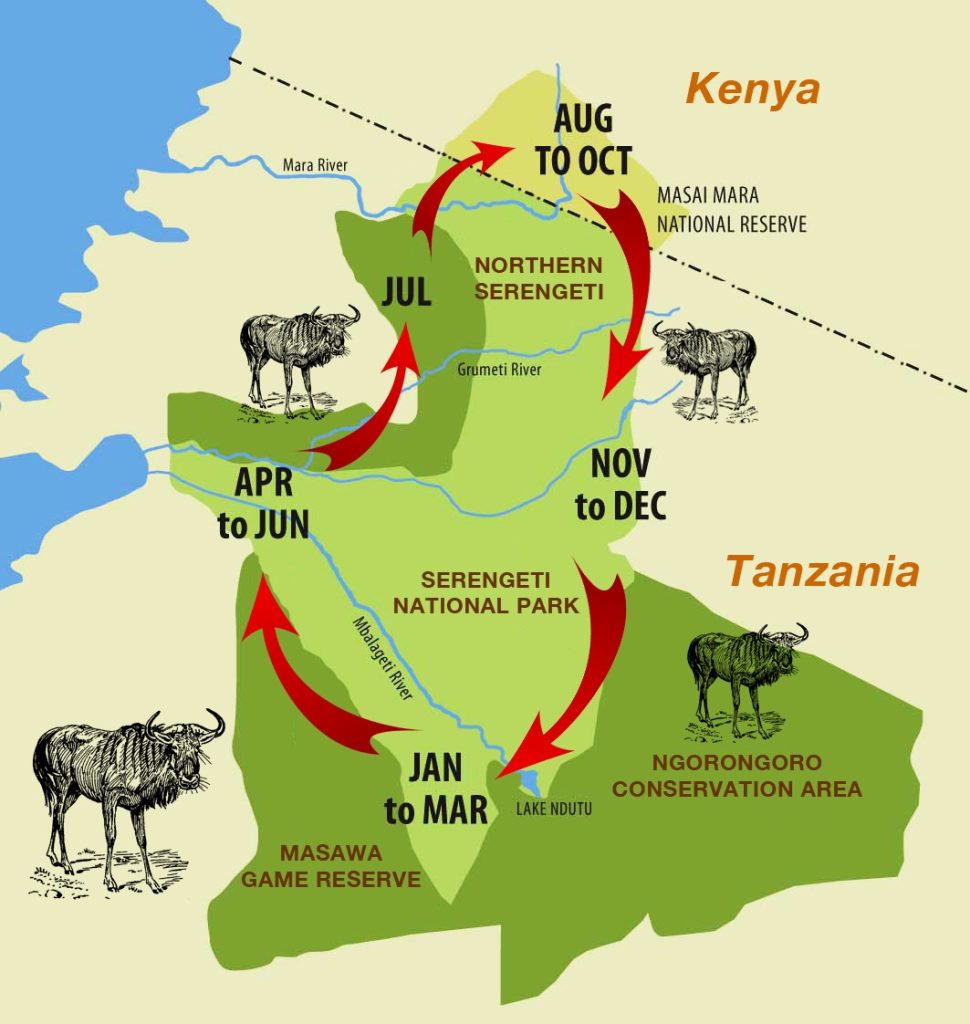

When does the Great Wildebeest Migration happen in Tanzania and when is the wildebeest migration in the Masai Mara, Kenya?
Throughout the entire year, the wildebeest herds are always in Tanzania. For a short time of the year some of the herds are in Kenya. This time period is from July – October when the wildebeest are always crossing the Mara River in Tanzania between Kogatende and the Lamai wedge (the land between the Mara River and the border to Kenya). The herds are sometimes crossing the Mara river from one side of the Masai Mara to the other (all in Kenya). So the famous river crossings are most likely to be seen in Tanzania. Tanzania also has far fewer tourists on any one crossing, so we would always recommend basing yourself in northern Serengeti as opposed to the Masai Mara to catch the wildebeest crossing the Mara River.
Where to Stay for Serengeti Migration
For Calving Season : ( January to March )
As one of nature’s most intriguing spectacles, the Great Migration is often hailed as one of the greatest shows on earth. However, aside from its peak during the river crossings, where huge herds of wildebeest brave the waters of the Mara River, there is another much-sought-after period: calving season.
Occurring annually between December and March, the Great Migration’s calving season takes place in Tanzania’s southern Serengeti.
The wildebeest herds have also been found as far south as the Ngorongoro Conservation Area, spreading across its plains to feast on lush and fresh grasses brought about by the rainy season. Fresh grasslands provide the herds with the best conditions for raising their newborn calves.
If you’re interested in a Great Migration safari, particularly during calving season, you’ll need to stay somewhere close to the action! Read on to find some of the best camps and lodges to witness the Great Migration’s calving season.

River Crossing Season: ( July to October )
Only a few lodges are located close to the river on a permanent basis, several mobile tented camps provide temporary accommodation during the peak window of the Great Migration. Prices will rise during the peak months, so finding budget accommodation is not easy in this period.
Dramatic river crossings are integral to the Great Migration, as over two million wildebeest, zebras, and gazelles make their way across the vast East Africa plains of Tanzania’s Serengeti and Kenya’s Maasai Mara. It’s a journey for survival that draws close to half a million tourists worldwide.
The annual migratory pattern is somewhat predictable as it’s not always possible to know exactly where to see the mega herds in their full concentration. However, factors like rainfall and flooding can impact the timing of a herd’s river crossing and where you can experience the best view. This is why Discover Africa developed the free-to-use HerdTracker App, which helps ensure guides and guests can better plan a Great Migration safari.


